

 |
RacingBetter News |
| Saturday 9th May 2026 | |
Grand National 2026: The Complete Punter’s Guide to the World’s Greatest Race
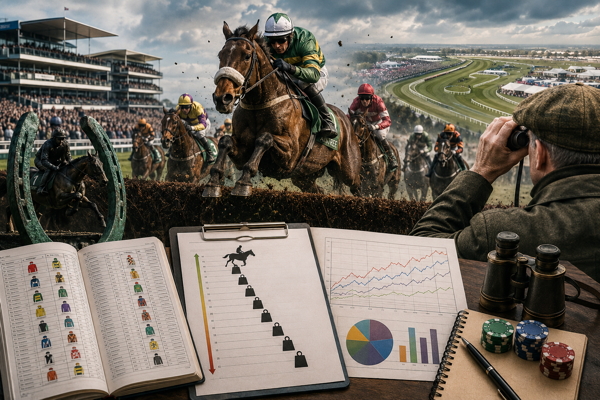
This guide is written for the UK punter who takes the Grand National seriously. It covers the 2026 field in full — entries, weight allocations, the handicapper’s intentions, trainer and jockey statistics at Aintree, current ante-post market analysis, each-way value runners, dark horse profiles, and a practical staking guide for race day. Nothing has been glossed over. If it matters at Aintree in April, it is here.
The 2026 Grand National Field — Entries, Weights and the First Cut
The weights for the 2026 Grand National were released by the British Horseracing Authority handicapper in mid-February, and the initial entries list ran to well over 100 horses before compulsory eliminations whittled the field down to the 40 runners that Aintree’s starting tape can accommodate. Understanding who got in, who was squeezed out, and what the weight allocations reveal about the handicapper’s thinking is the bedrock of any serious pre-race analysis. The handicap ceiling was set at 11st 10lb — the maximum any horse can carry — and the minimum at 10st, creating a 28lb spread across the field that reflects the wide range of ability levels the handicapper must accommodate in a 40-runner race over 4 miles 2½fd and 30 fences.
In 2026, the cut-off rating for inclusion in the field fell at 138, broadly consistent with recent renewals and confirming that the quality of the starting field remains high. Horses rated below that mark were eliminated first by weight, then by ballot. The horses clustered between 10st 6lb and 10st 12lb represent the handicapper’s sweet spot — deemed competitive without being so superior as to make the result a foregone conclusion. Trainers whose horses narrowly missed the cut often cite the lack of a confirmed starting berth as the primary reason for not targeting Aintree earlier in the season, meaning several potentially competitive runners were never prepared with the race in mind.
Trainer and Jockey Intelligence — Who Has the Edge at Aintree?
Statistics at Aintree in the Grand National context mean more than in almost any other race in the British calendar. Willie Mullins has transformed the complexion of the race over the past decade, saddling multiple winners including Galopin Des Champs in 2024 and I Am Maxxx in 2025, with his runners commanding premium market positions in 2026 once again. Gordon Elliott runs Mullins close in terms of Grand National representation, and his back-to-back Tiger Roll victories in 2018 and 2019 cemented his status as one of the race’s great training minds. Between them, the two Irish supertrainers have accounted for a significant proportion of the placed horses in recent renewals.
On the British side, Nigel Twiston-Davies and Venetia Williams carry the strongest statistical records among domestic trainers — both have produced multiple National runners and understand the preparation demands of a staying chase at this trip. Paul Townend’s riding style — patient, tactically aware, rarely panicked by traffic problems in the early stages — suits a race where the first mile is more about survival than position. Rachael Blackmore’s Grand National pedigree needs no introduction: her 2021 victory aboard Minella Times made history and her subsequent record at Aintree confirms she belongs among the elite. Sam Twiston-Davies has inherited his father’s understanding of what the National demands, and his recent Aintree record reinforces that assessment.
Analysis of Grand National winners over the past 20 years reveals a consistent profile. The typical winner is aged between nine and eleven, carries between 10st 3lb and 10st 11lb, has run at least once over 3 miles or further in the current season, and has a jumping record showing no tendency to make errors at Becher’s Brook, The Chair, or the Canal Turn. Fourteen of the last 20 winners fell in the nine-to-eleven age bracket, confirming this is not coincidence but the fingerprint of what the race requires. Horses who have previously run at Aintree carry a meaningful statistical advantage — course experience at this specific venue matters more than at any comparable British track.
The Ante-Post Market — Where Is the Money Best Spent?
The ante-post market for the Grand National opens within hours of the previous year’s race and moves in peaks: after Cheltenham, after the weights are released, and in the final 72 hours before the off. The key discipline in ante-post Grand National betting is not identifying the most likely winner — it is identifying the runners whose chance is not yet reflected in their price. The top four or five in the market going into race week almost always contain at least one horse whose price is inflated by reputation rather than data-led analysis. The 2026 market leader has drawn significant ante-post support on the back of a Cheltenham Festival performance, but its weight of 11st 2lb and lack of Aintree mileage place it in a historically unfavourable bracket. No horse carrying 11st 10lb has won the race since Red Rum in 1974.
The Grand National is as much a national cultural moment as a sporting event, and the digital landscape around it reflects that. Beyond the race itself, millions of UK viewers engage across a spectrum of online platforms on race day — streaming services, sports betting apps, fantasy racing tools, and slots sites UK punters visit between races on one of the busiest digital leisure days of the British calendar. The most consistently profitable approach in the betting market itself is each-way wagering on horses priced between 16/1 and 33/1 carrying weight between 10st 4lb and 10st 10lb. At a quarter the odds for the first five or six places, an each-way bet on a 25/1 shot returns approximately 6.25/1 for a place finish alone — a price that represents fair value for a horse the market rates as a 16/1 chance to hit the first five. Ante-post each-way bets struck before the weights are published regularly lock in prices that shorten 30–40% within 48 hours of the weight announcement, turning that compression into pure profit margin.
Ones to Watch — The Dark Horses Who Could Spring a Surprise
Every Grand National produces at least one winner from outside the top ten of the market — often from much further back. The race’s history is riddled with 40/1 and 50/1 shots who combined the right profile with the right preparation and the right draw to upstage the fancied runners. Identifying them before race day requires moving beyond recent form and ratings to examine weight, age, going preference, jumping ability, and stable confidence. A horse whose price has contracted from 66/1 to 40/1 on stable money in the days before the race tells you considerably more than the raw number suggests.
In the 2026 field, a handful of runners carrying between 10st 4lb and 10st 8lb have shown form in the current season — particularly in the Midlands National and Scottish Grand National trials — that suggests their official ratings are behind the curve. The BHA’s ratings by definition lag slightly behind a horse’s current form, and a horse who has improved sharply in its two or three most recent outings may be running off a mark that doesn’t fully reflect where it is right now. Combined with a clearly documented preference for good-to-soft ground, a clean jumping record with few errors logged across career starts, and a staying pedigree by a sire with proven stamina influence, these horses represent the most rational starting point for an each-way wager at a double-figure price.
Going, Course Conditions and the Draw
No factor shapes a Grand National outcome more dramatically than the going. Analysis of the past 25 renewals shows the race has been run on good or good-to-soft ground in approximately 16 of them. Soft or heavy ground has produced winners in roughly seven of the sample. Aintree’s National fences — built on a different principle to conventional British steeplechase obstacles — reward a horse that meets its fences right and jumps economically, without wasting energy on extravagant aerial displays. The Chair stands at 5ft 2in, the tallest fence on the course, positioned directly in front of the grandstands. Becher’s Brook’s sharply sloping landing side and the Canal Turn’s near-90-degree left-hand turn immediately after landing have each ended races and careers across the event’s long history. In 2026, the long-range forecast points toward settled conditions going into race week, making the mid-range of the market — horses handling good ground competently — the logical hunting ground for value.
The draw is more significant than most punters credit. Horses drawn toward the outside in the early stalls are statistically more likely to encounter traffic problems at the first fence, while those drawn too low risk being squeezed against the rails before the field settles. The optimal bracket historically falls between stalls 6 and 18, where horses have room to settle without exposure to either extreme. In a 40-runner field the ballot numbers carry practical consequences, and the confirmed draw — released on the Thursday before the race — should be factored into final stake decisions.
Race-Day Strategy — Staking Plans and Market Timing
The Grand National is not a race to approach with a single-minded, all-in staking approach. The combination of 40 runners, a unique course, and the inherent unpredictability of a race covering over four miles and 30 fences means even the most diligently researched selection can exit at the first fence through no fault in the analysis. The most rational staking structure involves splitting the total race-day budget across three or four each-way selections rather than concentrating it on a single runner. A total budget of £100 spread across four each-way bets of £12.50 each — £25 total commitment per selection, split between win and place — provides coverage of multiple outcomes without overexposure to any single result.
Almost every major UK bookmaker offers a Best Odds Guaranteed promotion on the Grand National, meaning that if a selection’s starting price on race day is higher than the ante-post price, the bookmaker pays out at the higher SP. A horse whose price compresses from 33/1 to 20/1 on ante-post money but whose SP drifts back to 28/1 on race day would be paid at 28/1 under BOG terms. Selecting a bookmaker who offers BOG on Grand National ante-post bets and locking in early prices on value runners is not a marginal gain — over a five-year sample it represents a meaningful percentage increase in return on staking. The betting exchanges — principally Betfair — offer traders an in-running market that moves dramatically once the race is underway, with horses jumping cleanly and travelling well seeing their prices compress rapidly between fences 9 and 14, when the genuine contenders become identifiable.
How to Approach the Grand National in 2026
Every piece of data in this guide points toward the same fundamental truth about the Grand National: it rewards preparation, patience, and the willingness to back informed judgement at a price the market hasn’t yet caught up with. Before placing any Grand National bet in 2026, run through the following checklist: confirm your selection’s official weight sits between 10st 3lb and 10st 11lb for the best statistical profile; check the horse’s going record against the forecast conditions; verify the trainer’s Aintree Grand National strike rate across at least the past ten years; confirm the jockey booking and their specific Aintree record; check the horse’s jumping error rate across its last ten chase starts; and lock in your best ante-post price with a BOG bookmaker before the final market moves on the Thursday.
The three bet types carrying the most analytical logic for 2026 are: ante-post each-way on a horse in the 10st 4lb to 10st 10lb weight range, priced between 16/1 and 33/1, with Aintree experience and a proven going preference; a race-day each-way position covering three horses at prices of 20/1 or greater; and an in-running exchange position on a horse jumping cleanly and travelling well at the midpoint of the first circuit. The authoritative sources for race-day information are the BHA’s official declarations list, published no later than 10am on the Thursday before the race, and Aintree Racecourse’s live going updates refreshed every two hours in the days leading up to the race. The Grand National does not guarantee the prepared punter a winner. It does guarantee that the unprepared one is betting in the dark.